• Home
  • About Us
  • Contact
  • Services
    • Needs To Know
    • Needs To Know
    • Frequency of Testing
    • Fixed Wire Testing
    • Emergency Lighting
    • Energy Management
    • PLC TROUBLESHOOTING
    • LEARNING CENTER
  • LEARNING CENTER
  • LEARNING CENTER
  • More
    • Home
    • About Us
    • Contact
    • Services
      • Needs To Know
      • Needs To Know
      • Frequency of Testing
      • Fixed Wire Testing
      • Emergency Lighting
      • Energy Management
      • PLC TROUBLESHOOTING
      • LEARNING CENTER
    • LEARNING CENTER
    • LEARNING CENTER
  • Sign In
  • Create Account

  • Bookings
  • My Account
  • Signed in as:

  • filler@godaddy.com


  • Bookings
  • My Account
  • Sign out

Signed in as:

filler@godaddy.com

  • Home
  • About Us
  • Contact
  • Services
    • Needs To Know
    • Needs To Know
    • Frequency of Testing
    • Fixed Wire Testing
    • Emergency Lighting
    • Energy Management
    • PLC TROUBLESHOOTING
    • LEARNING CENTER
  • LEARNING CENTER
  • LEARNING CENTER

Account


  • Bookings
  • My Account
  • Sign out


  • Sign In
  • Bookings
  • My Account
Electrical Safety Testing

Clean Energy. Smarter Maintenance. Safer Buildings.

Clean Energy. Smarter Maintenance. Safer Buildings. Clean Energy. Smarter Maintenance. Safer Buildings. Clean Energy. Smarter Maintenance. Safer Buildings.

Electrical Solutions That Save You Energy and Money

Energy Evolution Essentials for Modern Facilities

For Biomedical Testing Click Here
Learn More

Services

✅ Benefits of Energy Audits • 💰 Cost Savings Detect energy waste and reduce monthly utility expenses. • ⚙️ Equipment Efficiency Ensure systems like motors, HVAC units, and lighting are operating at peak performance. • 🎁 Rebates & Incentives Take advantage of local utility programs and government energy-efficiency grants. • 📜 Compliance Stay compliant with codes and standards (e.g., Title 24, ASHRAE, NFPA 70B). • 🌱 Sustainability Goals Reduce carbon emissions and work toward LEED or Energy Star certification.


🔌 Electrical Energy Audits: Overview

An electrical energy audit is a comprehensive assessment of how energy is consumed in a facility. The goal is to identify inefficiencies and recommend cost-effective measures to reduce energy usage, improve performance, and ensure regulatory compliance.


✅ Benefits of Energy Audits

  • 💰 Cost Savings


🔌 Electrical Energy Audits: Overview

An electrical energy audit is a comprehensive assessment of how energy is consumed in a facility. The goal is to identify inefficiencies and recommend cost-effective measures to reduce energy usage, improve performance, and ensure regulatory compliance.


✅ Benefits of Energy Audits

  • 💰 Cost Savings
        Detect energy waste and reduce monthly utility expenses.
  • ⚙️ Equipment Efficiency
        Ensure systems like motors, HVAC units, and lighting are operating at peak      performance.
  • 🎁 Rebates & Incentives
        Take advantage of local utility programs and government energy-efficiency      grants.
  • 📜 Compliance
        Stay compliant with codes and standards (e.g., Title 24, ASHRAE, NFPA      70B).
  • 🌱 Sustainability Goals
        Reduce carbon emissions and work toward LEED or Energy Star certification.


🏨 Hotel Energy Saving Opportunities

  • Upgrade to LED lighting in guest      rooms, lobbies, and signage
  • Install occupancy sensors for      lighting and HVAC control in rooms
  • Optimize HVAC systems (chillers,      boilers, thermostats)
  • Replace with high-efficiency      motors and add variable frequency drives (VFDs)
  • Perform compressed air system      analysis to detect leaks
  • Manage peak demand and implement      load shedding strategies       

❄️ Cooling and 🧹 Cleaning Dust: How They Save Energy and Extend Equipment Life

Proper cooling and cleaning of dust are essential for the efficient operation and longevity of electrical equipment. Neglecting these practices leads to overheating, energy waste, and premature failure of components.


🔌 1. Energy Cost Savings

  • Reduced Overheating: Dust buildup acts like an      insulator. It traps heat on components such as transformers, switchgear,      VFDs, circuit breakers, and motors. When equipment runs hotter, it      consumes more energy to maintain performance.
  • Efficient Airflow: Clean cooling vents and fans      allow air to flow freely through electrical panels, switchgear, and HVAC      systems. This reduces the load on cooling fans, compressors, and air      conditioners.
  • Lower Cooling System Demand: When electrical rooms or panels      are kept clean and well-ventilated, air conditioning units don’t have to      work as hard, cutting energy use significantly.


⚙️ 2. Longer Equipment Life

  • Prevents Overheating Damage: High temperatures degrade      insulation, contacts, and circuit boards. Clean, cool systems maintain      safe operating temperatures, preventing early failure.
  • Avoids Arcing and Tracking: Dust, especially if mixed with      humidity or oils, can lead to tracking or arcing on circuit boards and      breakers. Cleaning helps prevent dangerous electrical faults.
  • Extends Service Intervals: Well-maintained equipment has      fewer breakdowns and needs fewer replacements or repairs, reducing overall      maintenance costs.


📉 Example of Cost Impact:

  • A dusty motor running 10°F hotter      than normal can lose 2–3% efficiency.
  • A clogged VFD cooling fan can      cause shutdowns or derating, costing thousands in downtime and      repairs.


✅ Best Practices:

  • Schedule regular preventive      cleaning (per NFPA 70B, at least every 3–5 years).
  • Use vacuum and dry wipe      methods—avoid blowing dust into enclosures.
  • Monitor ambient temperatures in      electrical rooms.
  • Ensure fans, filters, and A/C      coils are cleaned routinely.

🏭 ABB & Baldor Motors and VFD Sales — Your One-Stop Solution for Industrial Applications, Service


🏭   

We provide everything you need in one place:

• Electric Motor Sales & Professional Installation
• ABB Variable Frequency Drive (VFD) Sales, Setup & Programming
• Full-Service Maintenance & Expert Troubleshooting
• Reliable Repair & Rebuild Services for Motors and Drives

Whether you're upgrading, replacing, or maintaining your equipme


🏭   

We provide everything you need in one place:

• Electric Motor Sales & Professional Installation
• ABB Variable Frequency Drive (VFD) Sales, Setup & Programming
• Full-Service Maintenance & Expert Troubleshooting
• Reliable Repair & Rebuild Services for Motors and Drives

Whether you're upgrading, replacing, or maintaining your equipment, we deliver dependable solutions backed by years of hands-on industry experience.

Variable Frequency Drive (VFD) Installing Inspection, Cleaning, and Preventive Maintenance

Variable Frequency Drive (VFD) Installing Inspection, Cleaning, and Preventive Maintenance

 We provide comprehensive preventive maintenance services for Variable Frequency Drives (VFDs)to ensure efficient performance, extend equipment lifespan, and prevent unplanned downtime. Our services align with manufacturer guidelines, IEEE standards, and best industry practices.


🔍 Inspection Services:

•Visual inspection of drive enclosur

 We provide comprehensive preventive maintenance services for Variable Frequency Drives (VFDs)to ensure efficient performance, extend equipment lifespan, and prevent unplanned downtime. Our services align with manufacturer guidelines, IEEE standards, and best industry practices.


🔍 Inspection Services:

•Visual inspection of drive enclosure, fans, and heat sinks •Check for signs of corrosion, dust buildup, or overheating •Verify tightness of power and control wiring connections •Inspect for damaged capacitors, relays, and PCB components •Check display panel, status LEDs, and error logs    

🧼 Cleaning Services:

•Power down and safely discharge capacitors before cleaning •Remove dust and contaminants using vacuum, dry air, or brush •Clean fans, air filters, heat sinks, and ventilation pathways •Wipe internal components with anti-static methods (as needed) Reassemble and confirm proper airflow   

🛠️ Preventive Maintenance Tasks:

•Check and record input/output voltage and current readings •Inspect and test cooling fan operation and replace if worn •Confirm grounding and shielding integrity •Verify communication interfaces and control signals •Backup VFD parameters/settings for restoration if needed •Ensure drive firmware is up to date (if applicable)    

📋 Documentation Provided:

•Maintenance and inspection checklist •Readings and condition report •Recommendations for repairs, upgrades, or part replacements •VFD health trend tracking (if recurring service)    

⚡Supported Equipment:

•Low-voltage and medium-voltage VFDs (230V–13.8kV) •HVAC, pump, and fan applications •Process control and motor drives  

🏭 Electrocution life Safety & Grounding Standards for Food and Beverage Facilities

🏭 Electrocution life Safety & Grounding Standards for Food and Beverage Facilities

Variable Frequency Drive (VFD) Installing Inspection, Cleaning, and Preventive Maintenance


🏭 Electrocution Safety & Grounding Standards for Food and Beverage Facilities

📘 Key Standards:

1.NFPA 70 (NEC) – National Electrical Code 2.NFPA 70E – Standard for Electrical Safety in the Workplace 3.NFPA 70B (2023) – Electrical Equipment Maintenance 4.IEEE 81 – Guide for Measuring Earth Resistivity, Ground Impedance, and Earth Surface


🏭 Electrocution Safety & Grounding Standards for Food and Beverage Facilities

📘 Key Standards:

1.NFPA 70 (NEC) – National Electrical Code 2.NFPA 70E – Standard for Electrical Safety in the Workplace 3.NFPA 70B (2023) – Electrical Equipment Maintenance 4.IEEE 81 – Guide for Measuring Earth Resistivity, Ground Impedance, and Earth Surface Potentials 5.IEEE 142 – Grounding of Industrial and Commercial Power Systems (Green Book)    

⚠️1. NFPA Electrocution Safety Requirements

✅NFPA 70E – Electrical Safety in the Workplace

•Applies to all facilities, including food & beverage plants. •Requires: ·Shock hazard risk assessmentfor any energized work ·Appropriate PPE for electrical tasks ·Lockout/Tagout (LOTO)procedures ·Training for all qualified personnel 

✅NFPA 70 (NEC) – Article 250: Grounding and Bonding

•All electrical systems must be effectively grounded •Key points for food/beverage facilities: ·Wet environmentsrequire equipment grounding conductors (EGCs)and ground-fault protection(GFCIs or GFP systems) ·Bonding of exposed metal partsis mandatory to avoid dangerous potential differences ·Stainless steel process equipmentmust be bonded to the facility ground 

✅NFPA 70B – Grounding Maintenance Requirements

•Now a standard (not recommended practice)as of 2023 •Requires: ·Periodic ground resistance testing ·Inspection and cleaning of ground electrode systems Verification of grounding continuityfor all bonded metal parts   

🧪 2. IEEE Ground Testing and Design Standards

✅IEEE 81 – Ground Testing Procedures

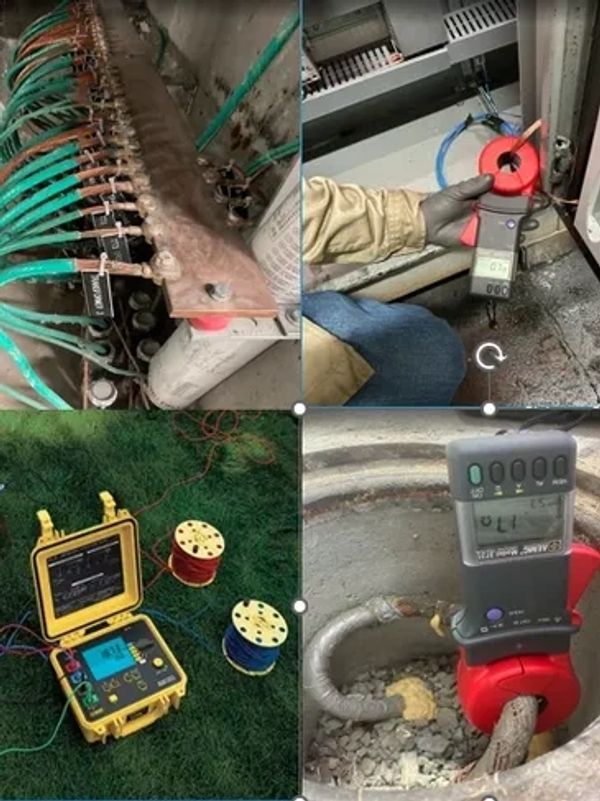
•Standard for measuring ground resistanceand soil resistivity using: ·Fall-of-potential method(preferred) ·Clamp-on testing (for operational systems) ·Step and touch potential analysis •Minimum acceptable ground resistance: ·Typically < 5 ohms for industrial facilities ·For sensitive or explosive areas (powder, flammable liquids), even < 1 ohm may be required 

✅IEEE 142 (Green Book) – Grounding Design

•Recommends: ·Use of ground rings, rods, and meshgrounding grids ·Separate grounding systemsfor sensitive electronics and heavy power systems (isolated and bonded at a single point) ·Use of equipotential bonding for metal pipes, tanks, and structures •Addresses lightning protection grounding, especially important in tall or isolated food production facilities    

🛑 Common Hazards in Food & Beverage Facilities

•Wet floors = high risk for shock and electrocution •Portable equipment = risk of poor ground connection •Corrosive cleaning chemicals= degrade ground connections and EGCs •Welding or heat-treating systems= require dedicated bonding and ground fault detection  

⚡ Underground Well Grounding TestingPrimary Testing Methods

🏭 Electrocution life Safety & Grounding Standards for Food and Beverage Facilities

⚡ Underground Well Grounding TestingPrimary Testing Methods


⚡Underground Well Grounding Testing

Underground well grounding systems must be tested to ensure low resistance to earth and proper bonding of all metal components. This ensures safe dissipation of fault currents, lightning, and static discharge — critical for systems with electrical pumps or controls.  

🛠️ Primary Testing Methods

1. Fall-


⚡Underground Well Grounding Testing

Underground well grounding systems must be tested to ensure low resistance to earth and proper bonding of all metal components. This ensures safe dissipation of fault currents, lightning, and static discharge — critical for systems with electrical pumps or controls.  

🛠️ Primary Testing Methods

1. Fall-of-Potential Test (3-Point Method)

Best for new installations or deep verification.

Procedure:

•Disconnect the grounding system from the well if possible. •Drive two auxiliary rods in a straight line from the well: ·One current probe ~100 feet away. ·One potential probehalfway (~62% distance). •Use a ground tester to send current and measure voltage drop. •The tester calculates the ground resistance (ohms). 

Standard:

•Resistance should be < 5 ohms(critical applications). •NEC allows < 25 ohms if only one ground rod is used, but multiple rods should achieve lower resistance.    

2. Clamp-On Ground Resistance Test

Used when the system must remain energized.

Procedure:

•Clamp the tester around the ground conductor connected to the wellhead. •Measures resistance of the entire grounding loop. •Cannot test isolated systems (must be part of a looped or ring ground). 

Best For:Routine inspections without disconnecting service.  

✅Testing Standards Referenced

•NFPA 70 (NEC) Article 250– Grounding & Bonding •IEEE 81 – Ground Testing Techniques •IEEE 837 – Permanent Grounding Connections •UL 467 – Grounding Equipment    

3. Continuity and Bonding Test

Purpose:Verifies that all conductive parts (piping, motor frames, wellhead casing, etc.) are electrically connected to the ground grid.

Procedure:

•Use a multimeter or continuity tester between each component and the ground conductor. •Resistance should be zero or near-zero ohms.  

Medium Voltage Cable Termination Services

🏭 Electrocution life Safety & Grounding Standards for Food and Beverage Facilities

⚡ Underground Well Grounding TestingPrimary Testing Methods

Voltage Range: 5.5kV to 15kV

We provide professional installation, termination, and testing of medium voltage cables rated from 5,500 volts up to 15,000 volts. Our technicians are trained to meet IEEE, NETA, and manufacturer standards for safety, reliability, and long-term performance.       

🔧 Services Include:

•Cable Preparation ·Proper s

Voltage Range: 5.5kV to 15kV

We provide professional installation, termination, and testing of medium voltage cables rated from 5,500 volts up to 15,000 volts. Our technicians are trained to meet IEEE, NETA, and manufacturer standards for safety, reliability, and long-term performance.       

🔧 Services Include:

•Cable Preparation ·Proper stripping of insulation and semi-con shielding ·Inspection for defects, damage, and contamination •Termination Installation ·Installation of heat shrink, cold shrink, or molded terminations ·Indoor and outdoor terminations for switchgear, transformers, and equipment ·Conductor shielding and stress cone application ·Proper grounding and sealing techniques •Splicing (if required) ·Inline splices for 5kV–15kV shielded cables ·Load break and dead break separable connectors •Testing and Verification ·Hi-pot (VLF or DC) testing ·Insulation resistance testing ·Partial discharge testing (if required) ·Visual and mechanical inspection post-installation •Documentation ·As-built cable reports Test data and termination certifications                      

🔋 Generator Load Bank Testing – NFPA

🔋 Generator Load Bank Testing – NFPA

🔋 Generator Load Bank Testing – NFPA

  Requirements & Compliance

📘 Relevant NFPA Standards

The key standards that govern generator testing are:

1.NFPA 110 – Standard for Emergency and Standby Power Systems 2.NFPA 70 (NEC) – National Electrical Code 3.NFPA 70B – Electrical Equipment Maintenance NFPA 99 – Health Care Facilities (if applicable) 


🧯 NFPA 110 Requirements (Most Cr

  Requirements & Compliance

📘 Relevant NFPA Standards

The key standards that govern generator testing are:

1.NFPA 110 – Standard for Emergency and Standby Power Systems 2.NFPA 70 (NEC) – National Electrical Code 3.NFPA 70B – Electrical Equipment Maintenance NFPA 99 – Health Care Facilities (if applicable) 


🧯 NFPA 110 Requirements (Most Critical Standard for Gensets)

NFPA 110 applies to emergency and standby power systems, especially in critical facilities (e.g., hospitals, airports, data centers).

Key Requirements (2022 edition):

🔹 Chapter 8 – Routine Maintenance and Operational Testing

•Monthly exercise under load ·Can be building load or simulated (load bank) if building load is insufficient •Annual load bank testrequired if monthly tests don't achieve at least 30% of generator’s nameplate rating for 30 minutes ·Per NFPA 110, 8.4.2.3, if monthly testing under building load does not meet this, an annual 2-hour load bank testis required · 

🔹 Load Bank Test Protocol:

1.30% of nameplate kW for 30 minutes 2.50% of kW for 30 minutes 3.75% of kW for 60 minutes 

Total = 2 hoursminimum duration


Copyright © 2024 Electrical Saftey Testing - All Rights Reserved.


Powered by

This website uses cookies.

We use cookies to analyze website traffic and optimize your website experience. By accepting our use of cookies, your data will be aggregated with all other user data.

Accept