EST Commercial & Industrial
  • Home
  • About Us
  • Service Industry
  • Testing and Training
  • More
    • Home
    • About Us
    • Service Industry
    • Testing and Training
  • Sign In
  • Create Account

  • Orders
  • My Account
  • Signed in as:

  • filler@godaddy.com


  • Orders
  • My Account
  • Sign out

Contact us

Signed in as:

filler@godaddy.com
  • Home
  • About Us
  • Service Industry
  • Testing and Training

Account

  • Orders
  • My Account
  • Sign out

  • Sign In
  • Orders
  • My Account
Contact us

Arc Flash Label Requirements from NFPA 70E 2024

CREATING AN ARC FLASH LABEL


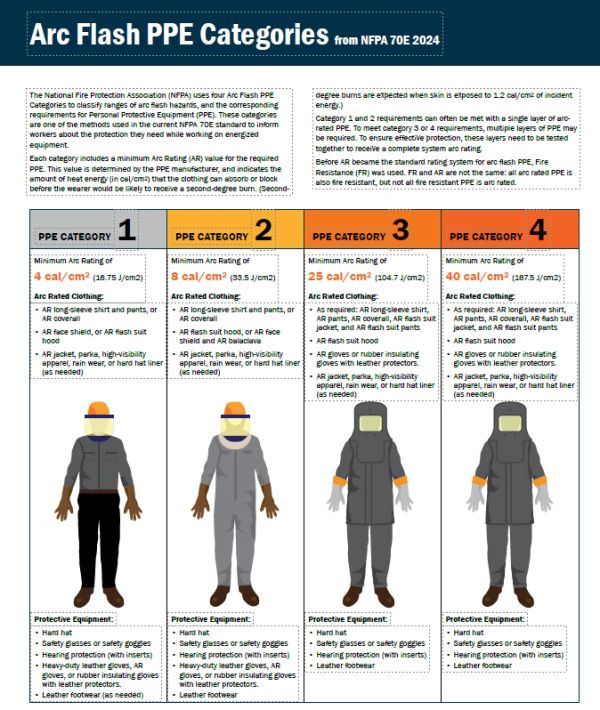
ARC FLASH PPE CATEGORY 

Rather than calculating the incident energy, your facility may choose to use the NFPA 70E Arc Flash PPE Categories. These categories, numbered from 1 to 4, group together equipment of roughly similar hazards and assign a set of required PPE to the entire category. A higher category number represents a higher level of protection needed. The categories are defined in table 130.7(C)(15)(c) in the NFPA 70E 

standard. 

In the 2012 edition of NFPA 70E, 

These categories were called Hazard/

Risk Categories, or HRCs, are included 

a category 0 for relatively low-risk 

equipment and procedures. The 2015 

edition removed category 0, and made 

slight adjustments to the requirements. 

Older labels that refer to HRCs need to 

be updated.

Nominal System Voltage

  • 1. Nominal System Voltage - The first label requirement, the nominal system voltage, offers a quick way to assess the potential shock hazard and general degree of danger represented by a system. It can be measured in VAC (volts, alternating current) or VDC (volts, direct current). Common values are 120, 208, 220, and 480, but high-powered systems can use much higher values.
  • 2. Arc Flash Boundary - The second label requirement, the arc flash boundary, is the distance from the equipment at which an unprotected person would receive second-degree burns in the event of an arc flash. Specifically, the energy at that point would be 1.2 calories (5 Joules) of heat energy per square centimeter of exposed area, or 1.2 cal/cm². This distance is calculated in a variety of ways, and the calculation method must be documented, although it does not need to appear on the label.

Arc Flash Risk Assessments. To provide effective protection from a hazard, you need to perform a risk assessment. NFPA 70E, 130.5(A) describes a basic risk assessment as having three broad steps:

  • Requirements: Assessing Risks
  • Once you have determined that a given task being performed will present an arc flash hazard, it’s time to assess the risk involved. How likely is an arc flash, given the type of work being performed and the equipment involved? How much energy would be released in an arc flash if one occurred during that work, and how severe could the worker’s resulting injuries be?
  • NFPA 70E, 130.5(F) offers two approaches for this step:

Gallery

    Industrial Energy‑Saving Opportunities

    Industrial facilities such as beverage plants, extrusion lines, and large manufacturing factories have some of the highest electrical loads in the commercial sector. Targeted upgrades can significantly reduce energy costs and improve system performance.

    Cooling & Dust Cleaning: Protecting Electrical Equipment

    Proper cooling and dust removal are essential for safe, efficient, and long‑lasting electrical equipment. Neglecting these practices leads to overheating, energy waste, and premature failure.

    Energy Cost Savings

    Dust traps heat on transformers, switchgear, VFDs, motors, and breakers.

    Clean vents and fans improve airflow and reduce load on HVAC systems.

    Cooler electrical rooms reduce the workload on A/C units.

    Cooler electrical rooms reduce the workload on A/C units.

    Longer Equipment Life

    • Prevents heat‑related damage to insulation, contacts, and circuit boards
    • Reduces arcing and tracking caused by dust mixed with humidity or oils
    • Extends service intervals and reduces unplanned downtime

    Copyright © 2026, EST Commercial & Industrial. All Rights Reserved.

    Powered by

    This website uses cookies.

    We use cookies to analyze website traffic and optimize your website experience. By accepting our use of cookies, your data will be aggregated with all other user data.

    Accept